
Over Christmas and New Year 2025/26, I was fortunate enough to spend 4 weeks in Patagonia. Photography wasn’t the only focus – I was there with my wife to do a load of trekking and rock climbing. However, when visiting multiple iconic locations, I had to give my photographic needs some serious consideration. Some of you reading this won’t be too bothered about the kit I took, but perhaps some of you might find this of interest. The next two paragraph are about the gear, so you can skip this is you prefer.
Camera gear
I would be lying if I didn’t say that I spent a lot of time thinking about what gear to take. We would be doing some very big trekking-days, covering a lot of distance (many consecutive days of 20+ and sometimes 30+ km per day) and so trying to be light-weight was important. However, I decided I would never forgive myself for travelling too light in this iconic location. I therefore settled on my Nikon Z7ii with two Nikkor zoom lenses – the 24-200mm and the 100-400mm. The bigger zoom was a significant extra weight, but I’m a fan of being able to pick out distant features, especially in mountain locations. I decided against taking a dedicated wide-angle lens (sub-24mm is probably my least-use focal range), favouring the telephoto zoom instead. I also took a Gitzo travel tripod, a set of Kase magnetic filters, a couple of spare batteries, and several memory cards. I managed to squeeze all of this into a Shimoda Action X30 (30 litres), along with trekking gear. I have a bigger Shimoda bag (50 litres) which I was very tempted to take. However, I knew I had to force myself to be as light-weight as I possibly could be, and if I let myself take the bigger bag, I knew I would fill it with extras. A smaller bag made some things tricky, but I did just about manage.
In addition, some time ago, I bought a little Nikon Z30. This is small and compact, and clips onto a climbing harness or rucksack waist-belt pretty easily. For some of our time in Patagonia, we would be on a dedicated climbing trip and I knew I simply wouldn’t have space for the Nikon Z7ii kit. The Z30 would therefore act as a lightweight ‘better-than-nothing’ option. However, I’ve got to say I have been blown away by this little camera. It has a crop sensor rather than full-frame, and a 20mp sensor rather than 45. However, the ‘better-than-nothing’ tag does it a gross disservice. The image quality is incredible and the flexibility of the raw files it generates is really something. As far as a I can tell, this little camera gets very little attention as a quality stills-camera, but it certainly deserves more and I can recommend it wholeheartedly.
Itinerary
Patagonia is a big old place and it wasn’t until my wife and I started our planning over a year ago, that we realised just how much decision making we would have to do in terms of where to go. We had a month at our disposal (mid-December to mid-January) and wanted to make the most of it. We decided to fly into Santiago in Chile (there are direct flights from Heathrow), and we spent a couple of nights there at the beginning of our stay, and again at the end. In between, we based ourselves in three separate locations – Puerto Natales (Chile); El Chaltén (Argentina) and finally Bariloche San Carlos (Argentina). We spent roughly a week in each. Our motivation for these choices was that Puerto Natales is the gateway to the Torres del Paine National Park, El Chaltén is the trekking capital of Patagonia and also home to Cerro Fitzroy and Cerro Torre, and finally Bariloche is famous for its Swiss-style architecture and its surrounding mountains and lakes.
Puerto Natales and the ‘W-trek’
Puerto Natales is a long way south in Chile and is the capital of the Última Esperanza province. – Última Esperanza means ‘Last Hope’ and was named by the Spanish explorer Juan Ladrillero as it was his last hope of finding the Strait of Magellan.
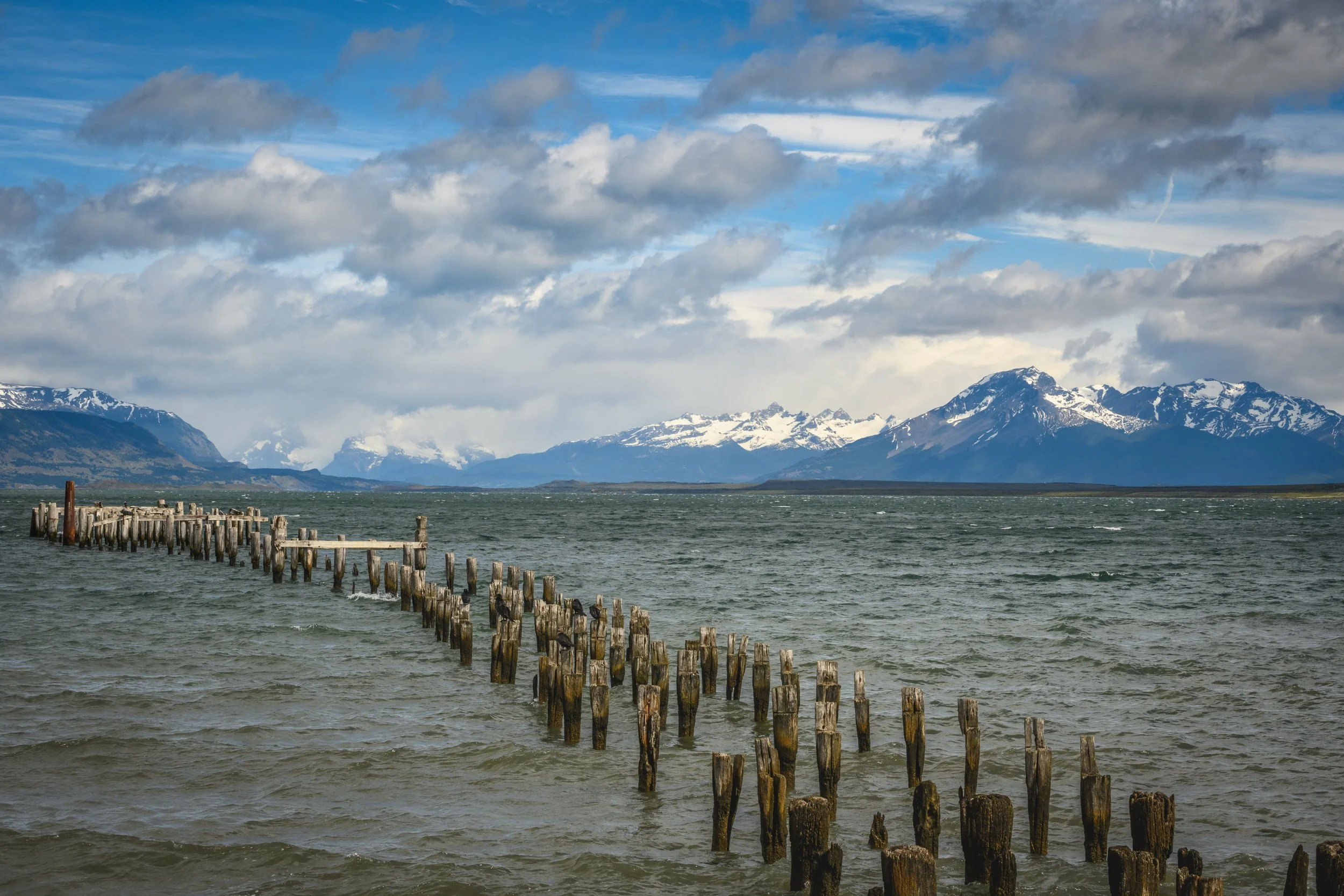
Looking west from the shores of Puerto Natales, across the Señoret Channel.
The first thing that hits you on arrival is the wild landscape and even wilder winds.
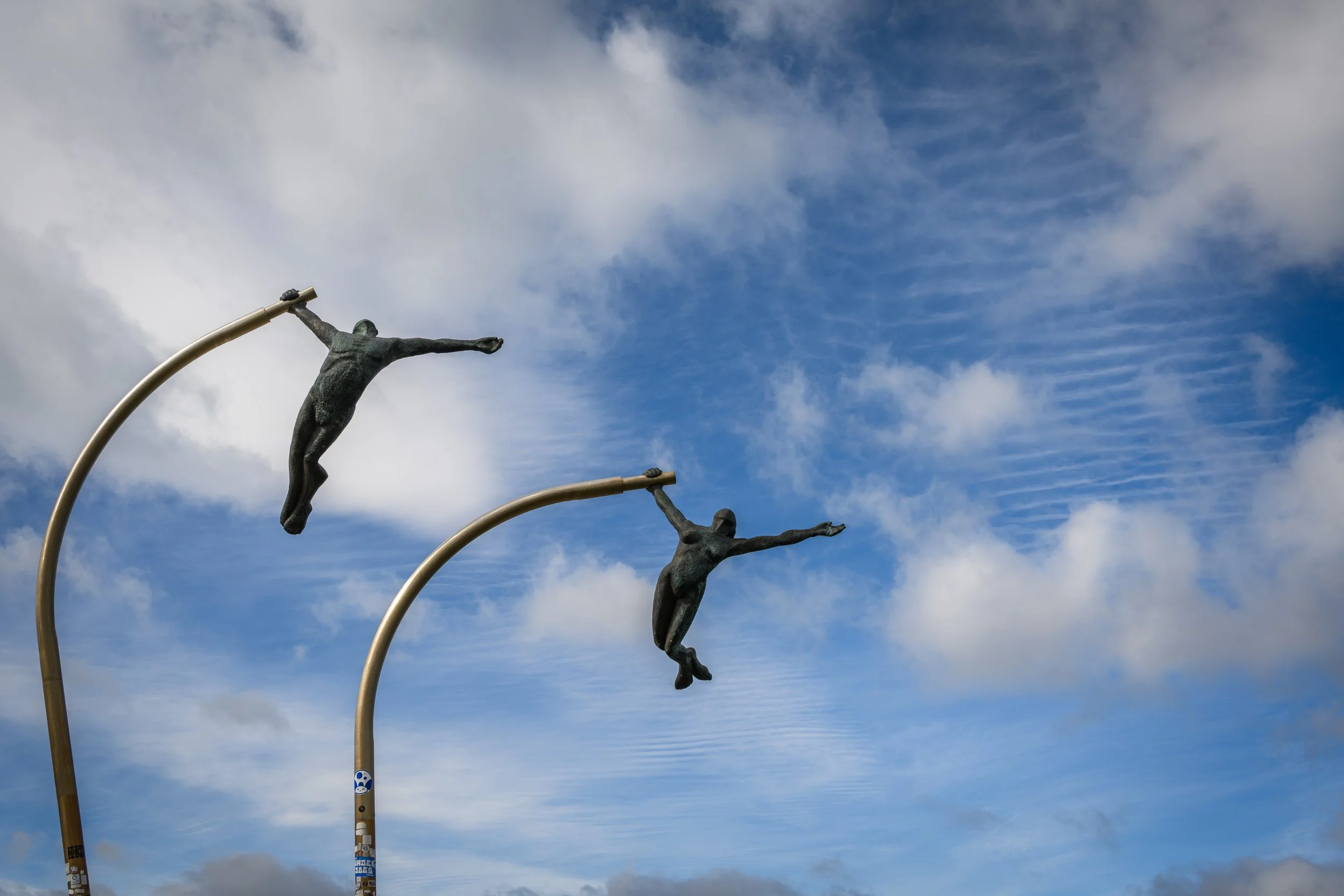
Monumento al Viento (Monument to the Wind) in Puerto Natales. Spectacular clouds were a feature of this very windy place.
The town is a strange and very appealing mixture of old, run-down buildings, and modern, high-end cafes and trekking gear shops.
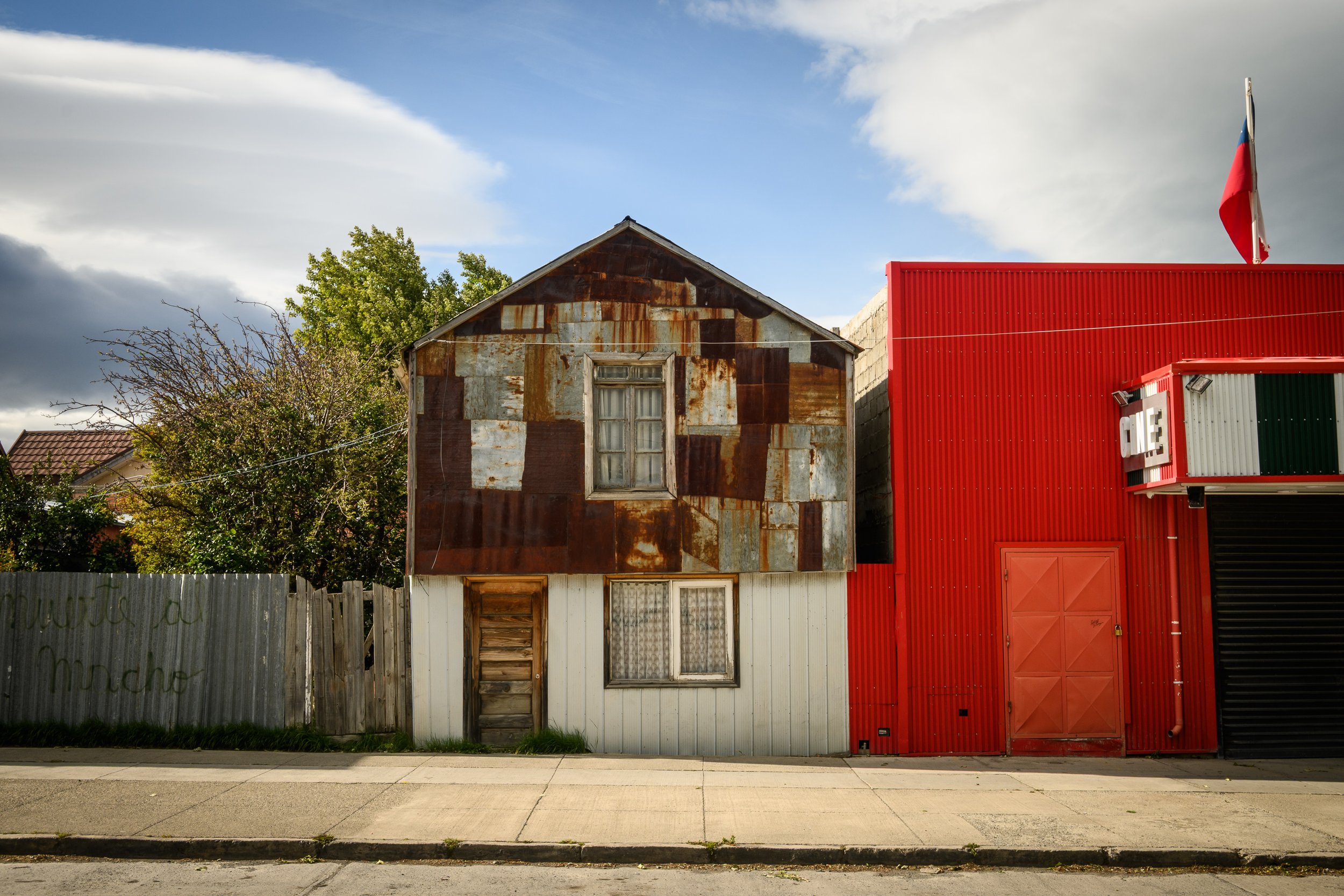
The ramshackle and the new of Puerto Natales.
We weren’t there for the town though, so after a short time there we headed out on the bus ride to the Torres del Paine National Park to embark on the ‘W-Trek’. This is an 80km multi-day trek around the mountains, valleys and lakes of the park.
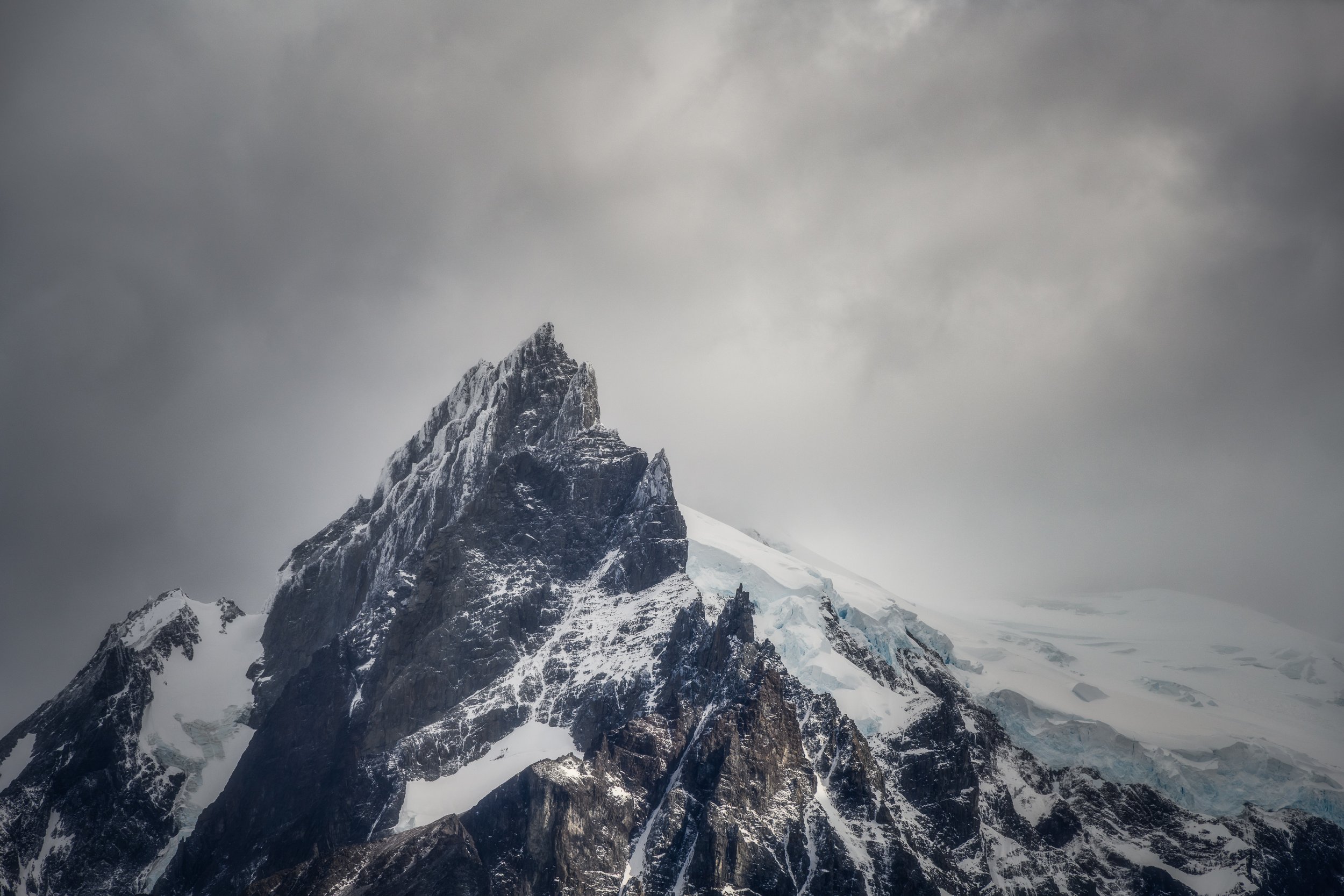
The summit of Paine Grande, inside the Torres del Paine National Park.
We started in the west, accessed by a thrilling high-speed catamaran ride, and then we spent 4 days on foot, making our way east. The catamaran ride gives you some early glimpses of what the trek holds, but taking photographs onboard as it bounces over the waves was a challenge. It’s so spectacular though, that it’s definitely worth trying to brace yourself and get some images.
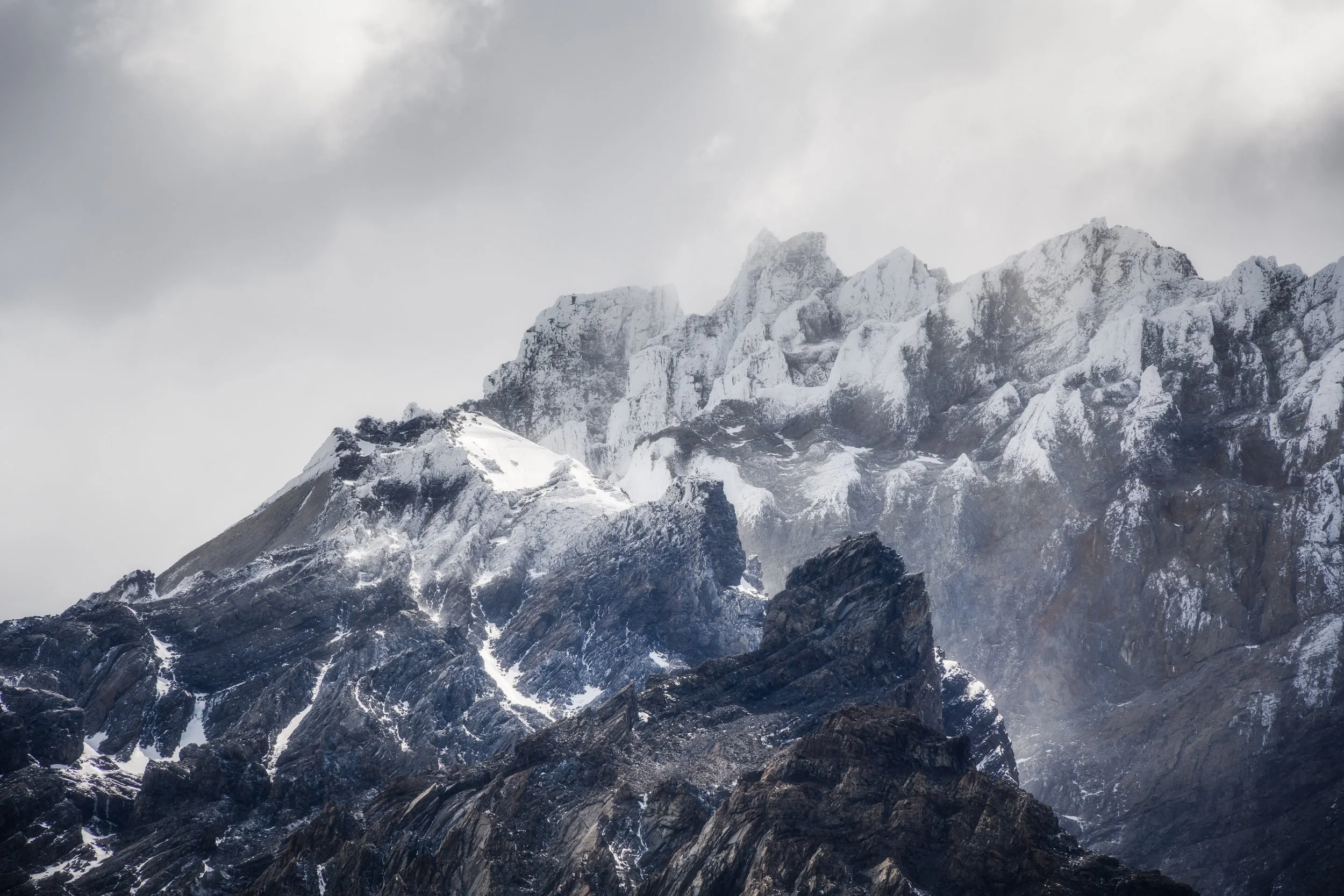
Spectacular ridge-lines dominmate the landscape in The Torres del Paine National Park.
After disembarking, we immediately started our walk. We elected not to carry camping gear, for the sake of weight, but rented all that we would need for sleeping, as well as either a room in a dorm or space in a tent that is permanently pitched at our 3 stopover campsites. The walk is very popular and one of the things we struggled with was there being so many people. Mountains are all about solitude to my mind. However, we managed to come up with a strategy for coping by getting up very early each morning and often being the first ones on the trail.
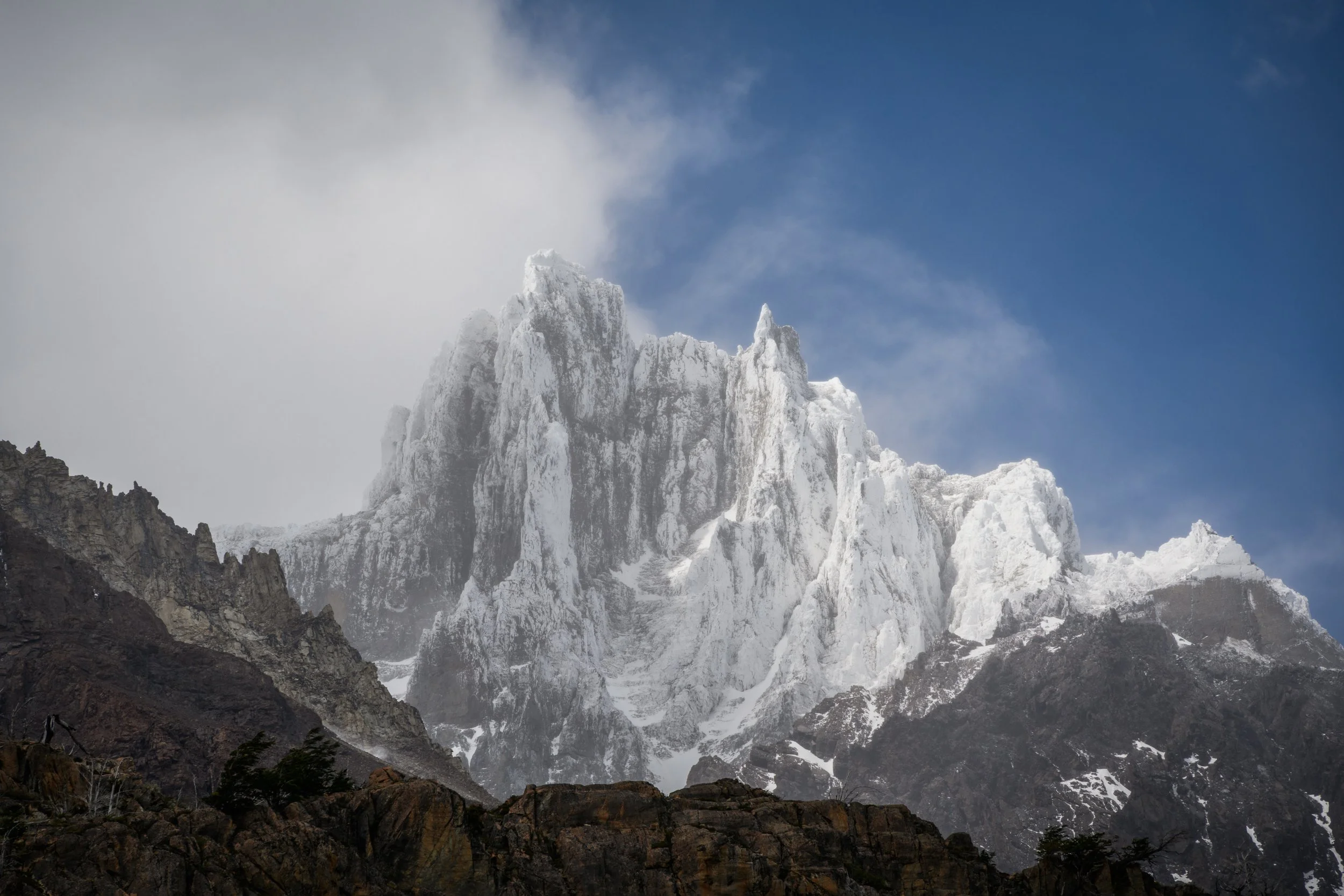
Punta Bariloche still covered in a lot of snow.
This really paid off and also gifted us with some amazing weather conditions. This was most notable on Christmas morning, as we made our way from Refugio Cuernos to Refugio Chileno, with not a soul about.
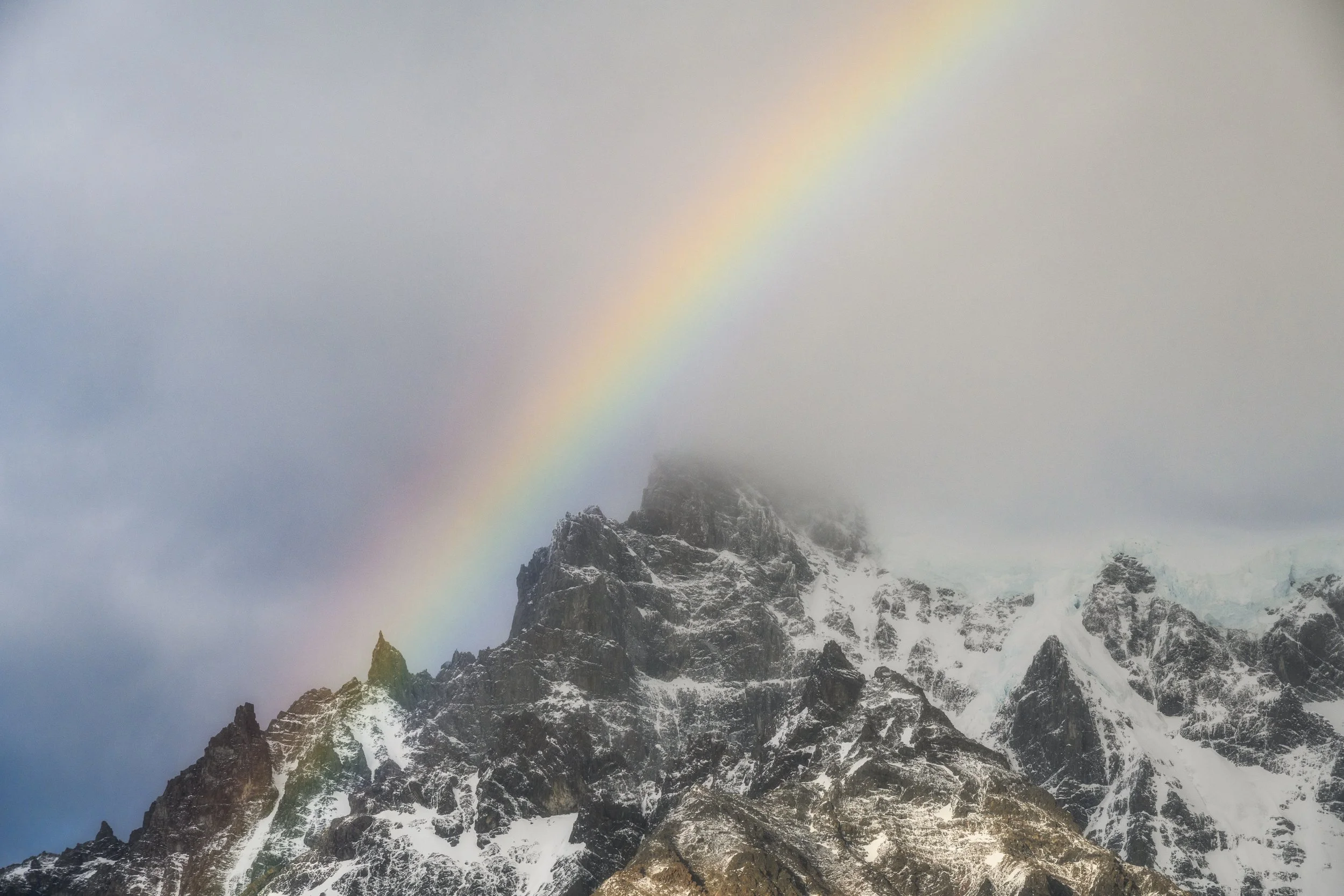
A Christmas morning Rainbow over the summits and ridges of the southern part of the Torres del Paine National Park. There was no one else around to enjoy this.
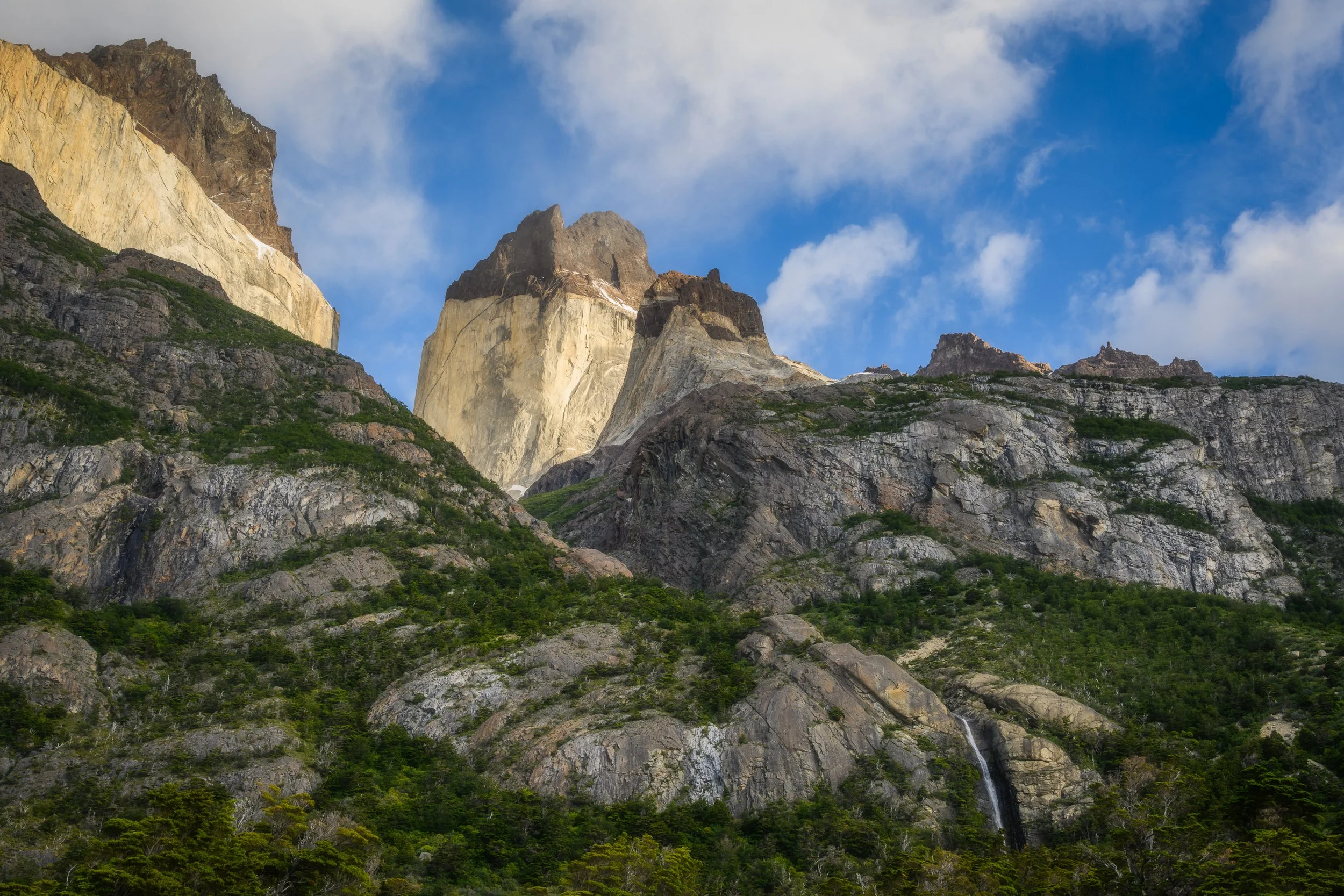
Stunning landscapes as we made our way towards the Torres del Paine on Christmas Day. Catching the sun in the background are the iconic peaks of Los Cuernos (The Horns).
The W-trek’s ultimate highlight comes pretty close to the end, with a visit to the base of the Torres del Paine. As a long-time climber and mountaineer, I’ve been aware of the Torres for a very long time, and so seeing them was quite an emotional experience.
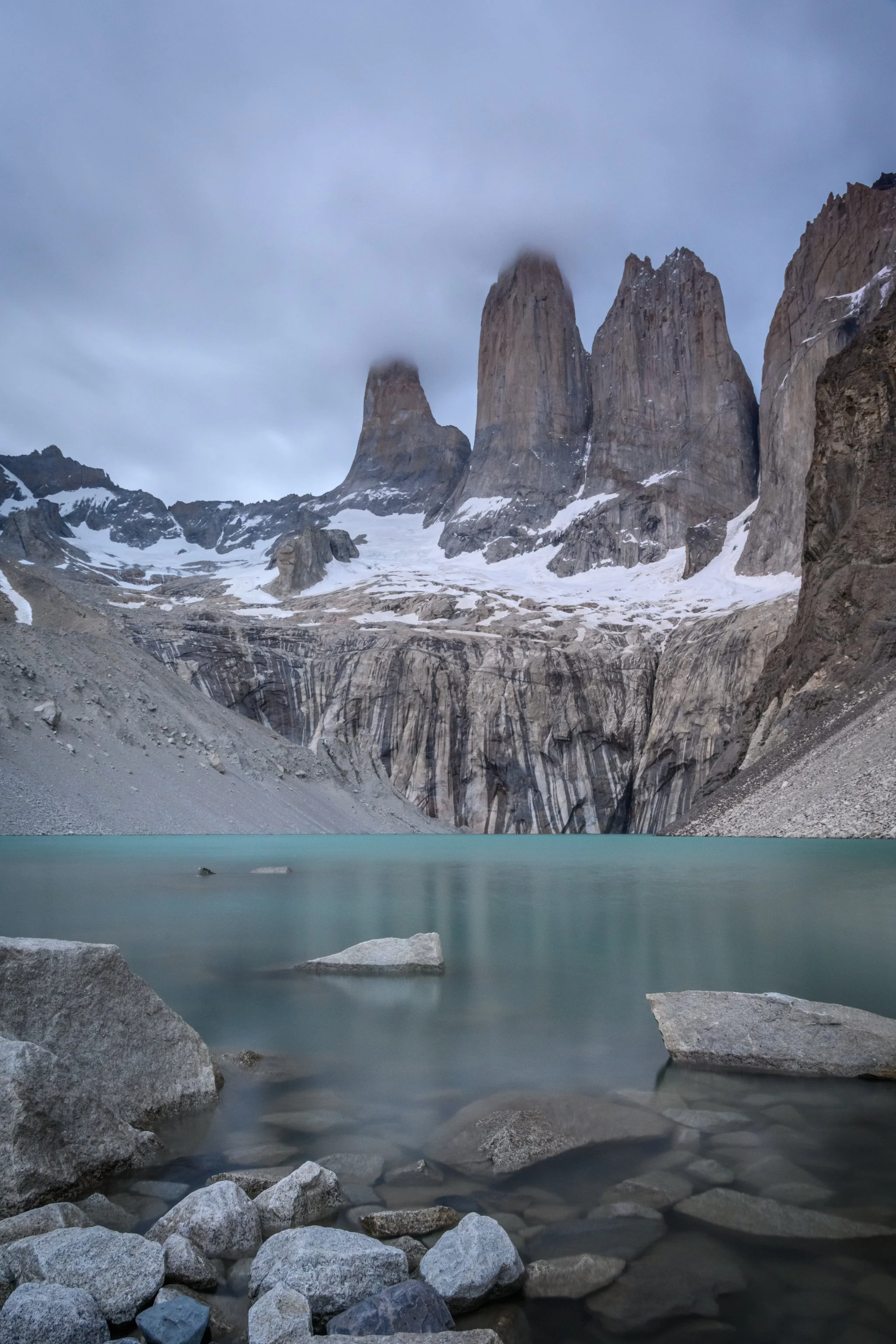
Shortly before 5am on Boxing Day at the foot of the spectacular Torres del Paine. Despite a strenuous, steep walk in the dark, and the lack of any sunrise colours, it was well worth it. After our very crowded visit the evening before, it was very quiet this early, with just a few other people… a precious experience in a special place.
It’s a very steep and strenuous hike/scramble up to the main viewing site, but we made the trip twice – the first time in the late afternoon, along with what felt like thousands of others. The second time was the following morning for sunrise, when we were lucky enough to only share the place with a handful of people. We didn’t get the morning glow, but even under relatively flat light, these towers are a thing to behold.
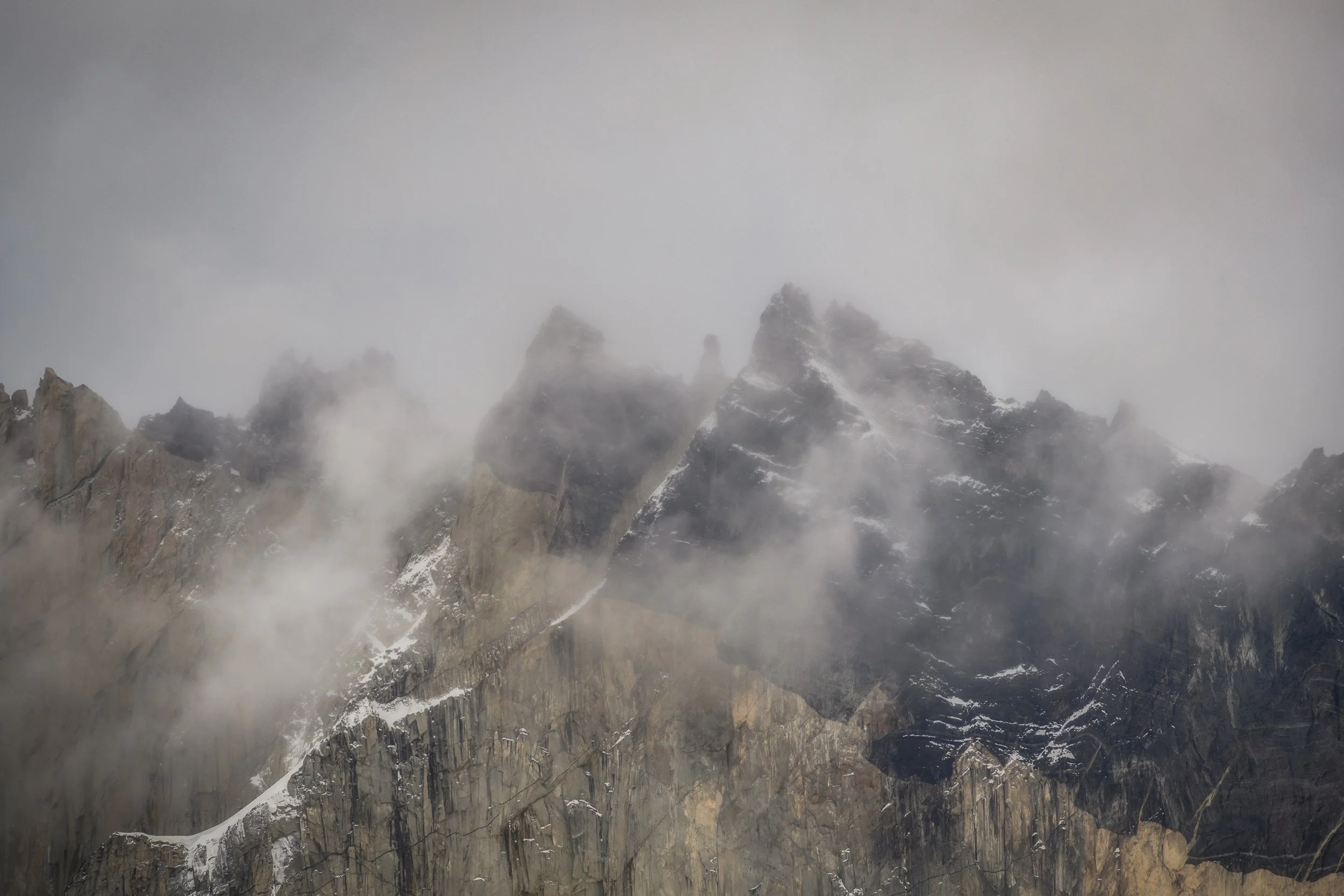
A mist-shrouded ridgeline close to the Towers.
Whilst the towers are the main pull, the 80km trek exposes you to lots of special scenery.
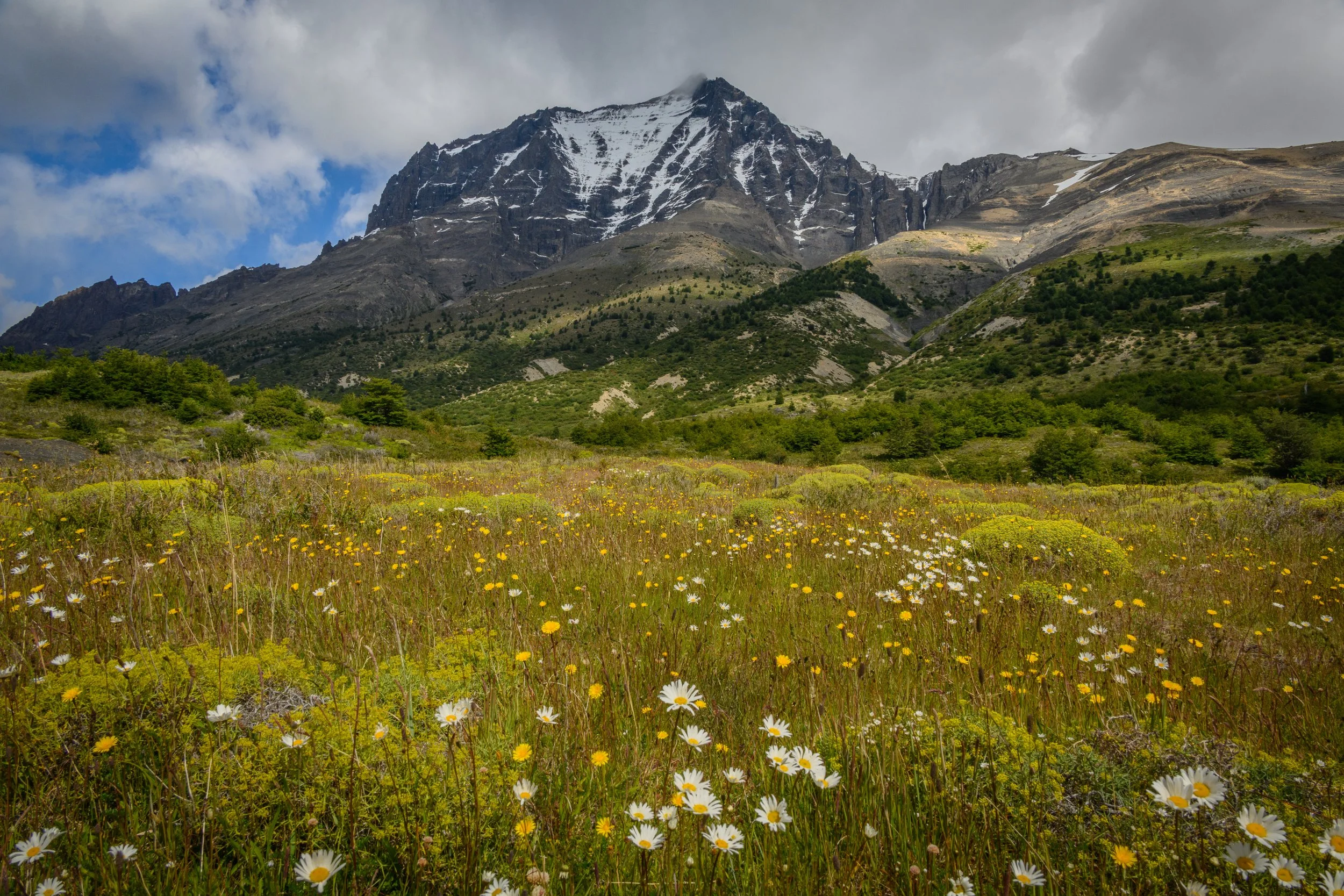
Meadows full of spring flowers dominate some parts of the trek, particularly towards the eastern end.
Many mountains and peaks loom above you, and there are also spectacular lakes with waves whipped up by the mad winds, and beautiful forests that bear the scars of many storms. It’s stunning.
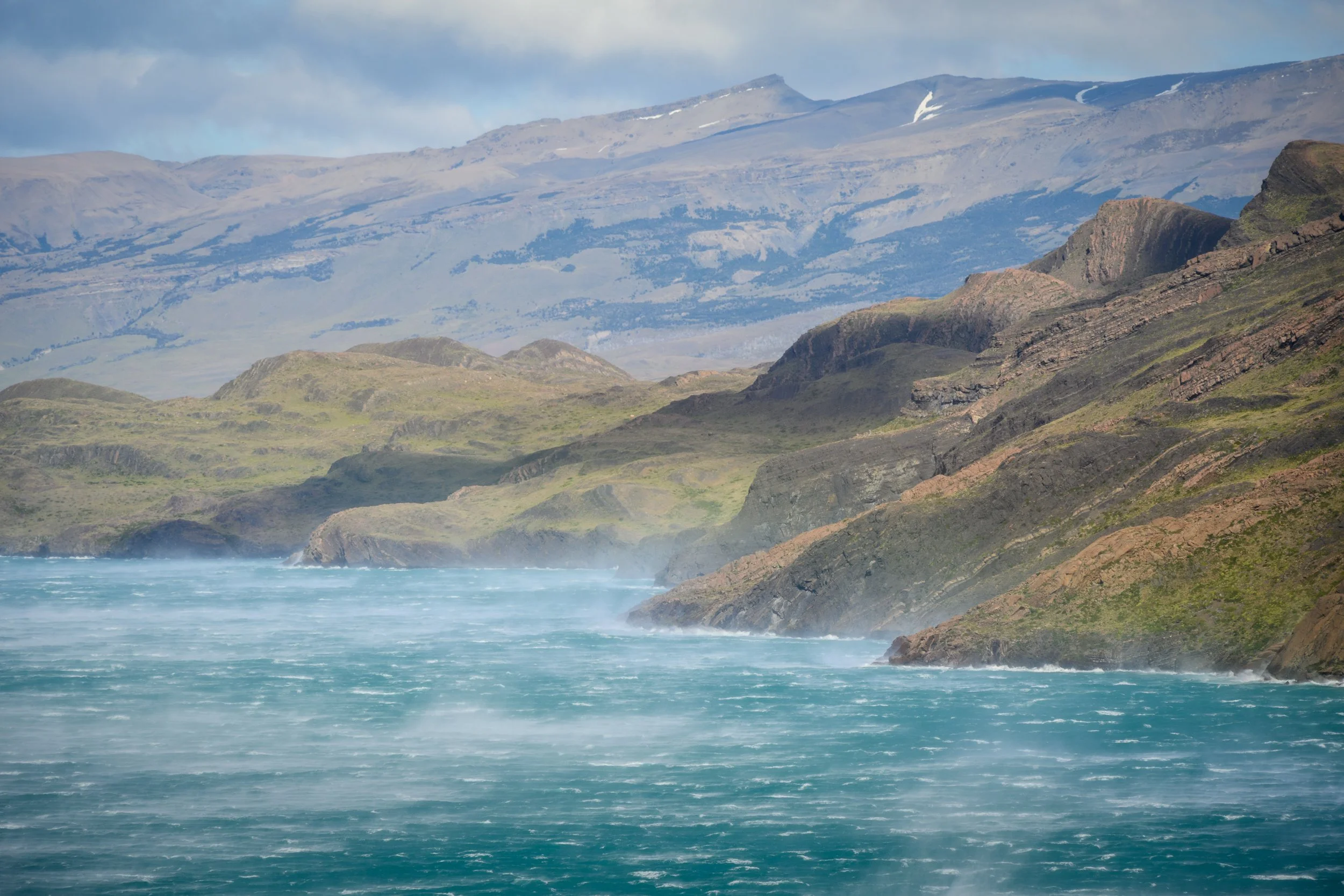
Wild winds whipping up waves on the surface of Lago Nordenskjöld.
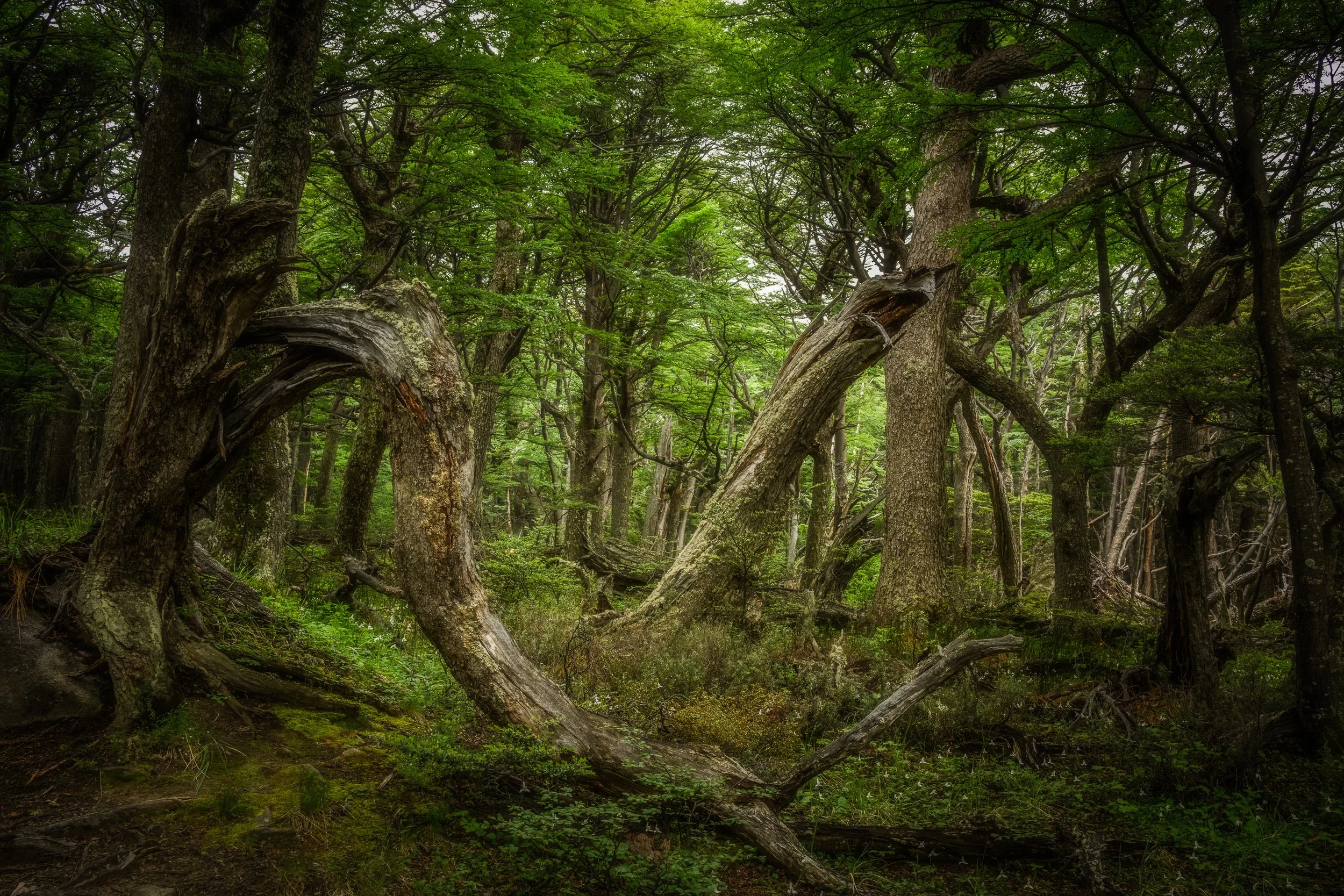
Inside one of the many beautiful, but damaged, forests.
El Chaltén
Our next destination took us into Argentina. El Chaltén is famous as the home to the stunning Fitzroy Massif (the logo of the outdoor clothing brand Patagonia is the Fitzroy skyline) as well as Cerro Torre. Cerro Fitzroy (the biggest peak in the Fitzroy range) and various subsidiary peaks are visible from many locations in and around El Chaltén.
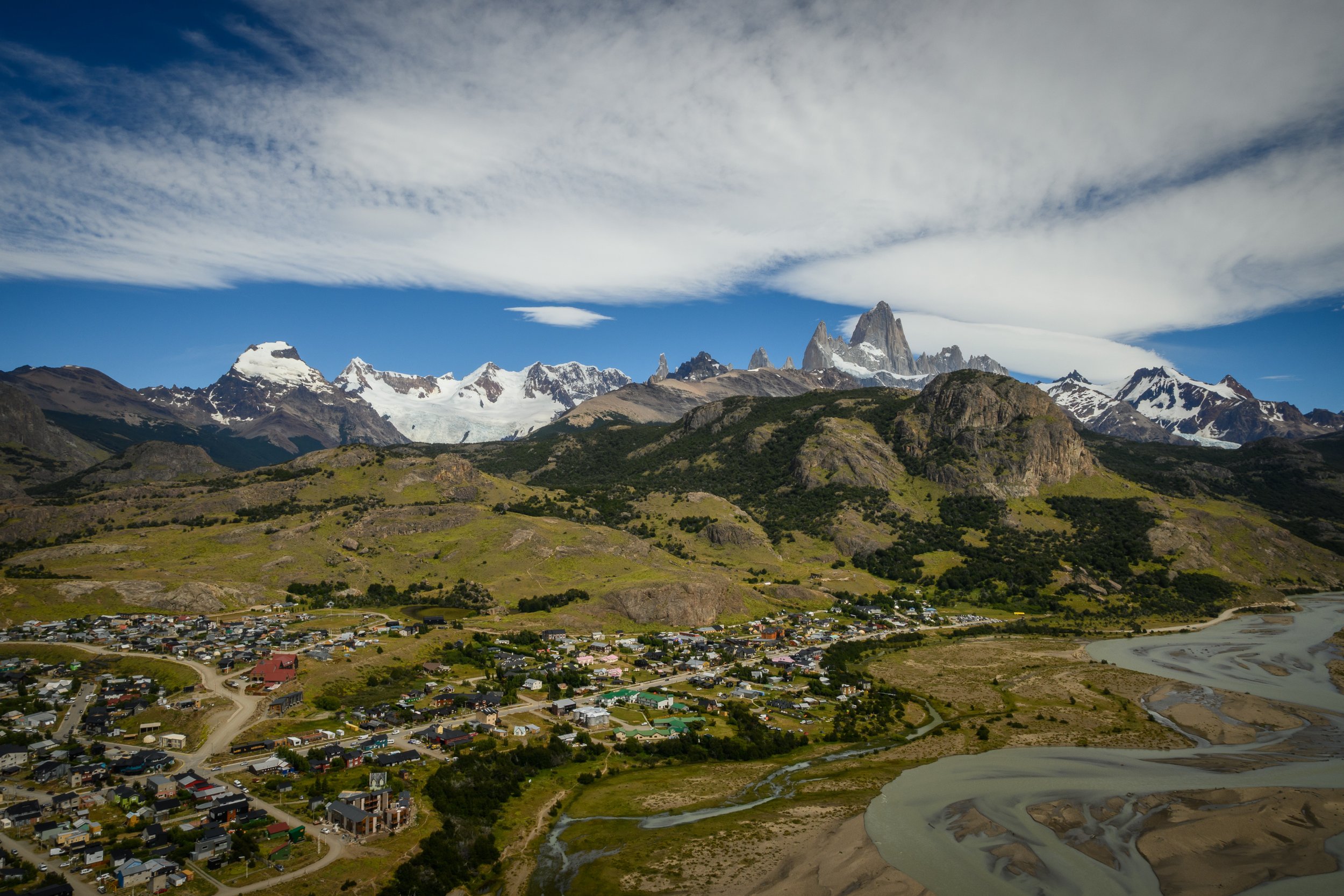
The Argentian town of El Chaltén, with the striking Fitzroy massif towards the right. Cerro Torre is also visible, but its prominent tower appears quite dimminutive from this angle. It can be seen to the left of the Fitzroy range.
It looms over you but it is spectacular, and seeing these iconic mountains was another long-term wish of mine, borne from many climbing and mountaineering books, films and pictures. It’s hard not to just take photos every time you see it, and in fact I think I did for several days.
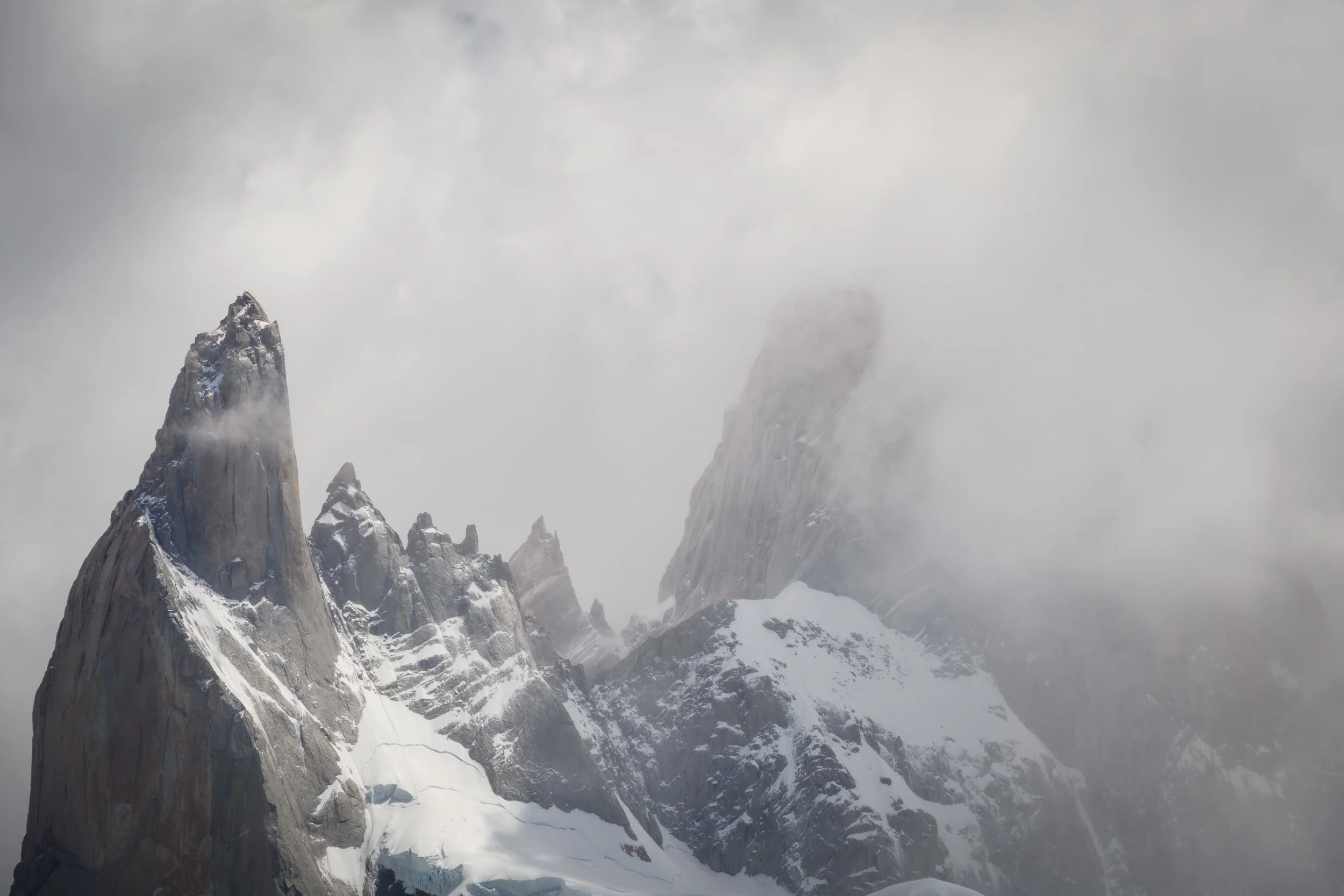
One of our earliest views of the Fitzroy massif. Cerro Fitzroy is largely obscured by cloud towards the centre-right, but Cerro Poincenot is clearly visble on the left. I worried that maybe we’d never see these stunning peaks, given the infamous Patagonian weather, so this early encounter had me very excited, particularly with the swirling cloud.
We spent our time in El Chaltén climbing and trekking to various different locations. As we learned on the W-trek, starting early has its benefits to try and get ahead of the enormous crowds that come here.
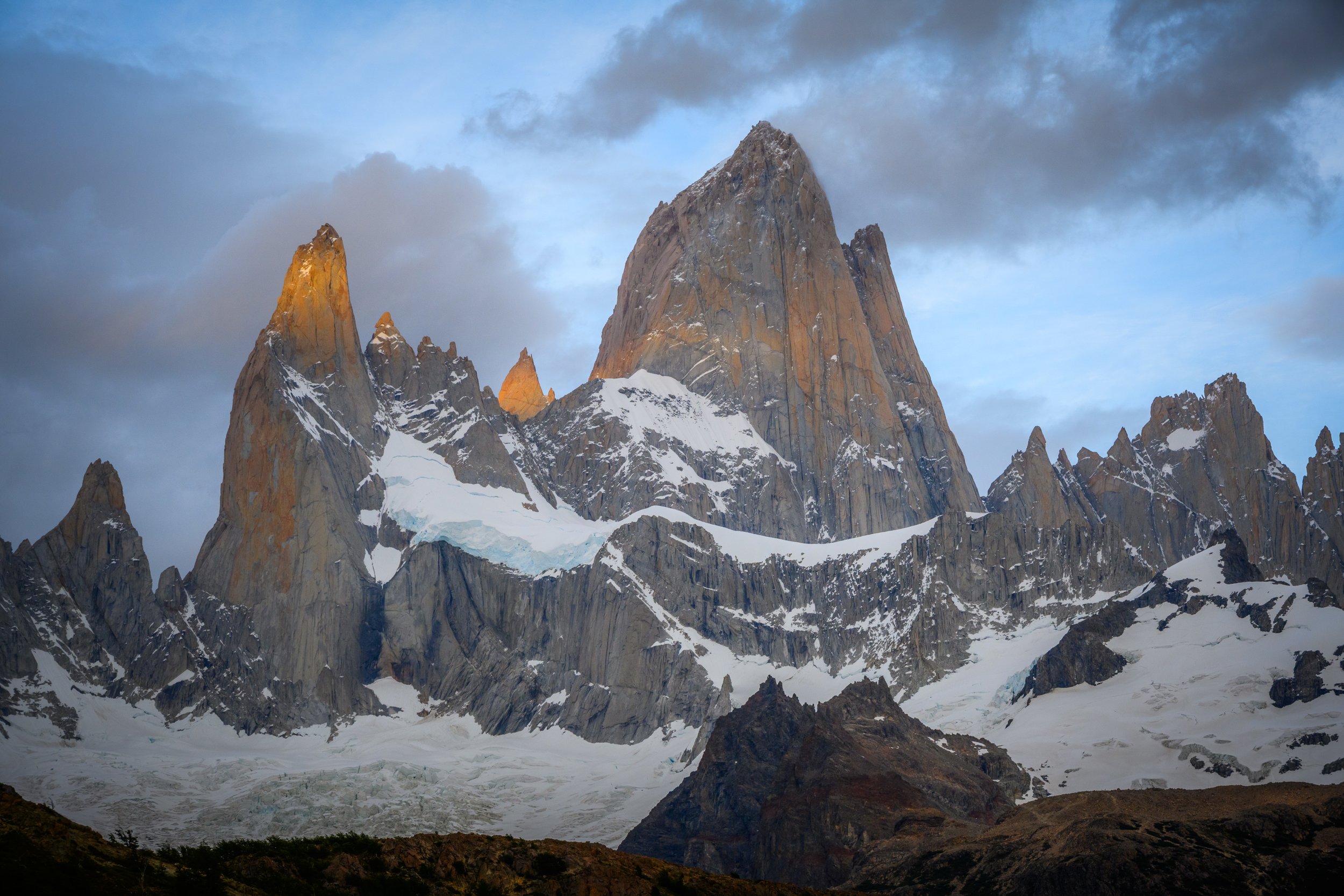
The extraordinary granite spires of the Fitzroy range, with the post-sunrise light catching some of them. Cerro Fitzroy itself is the largest summit.
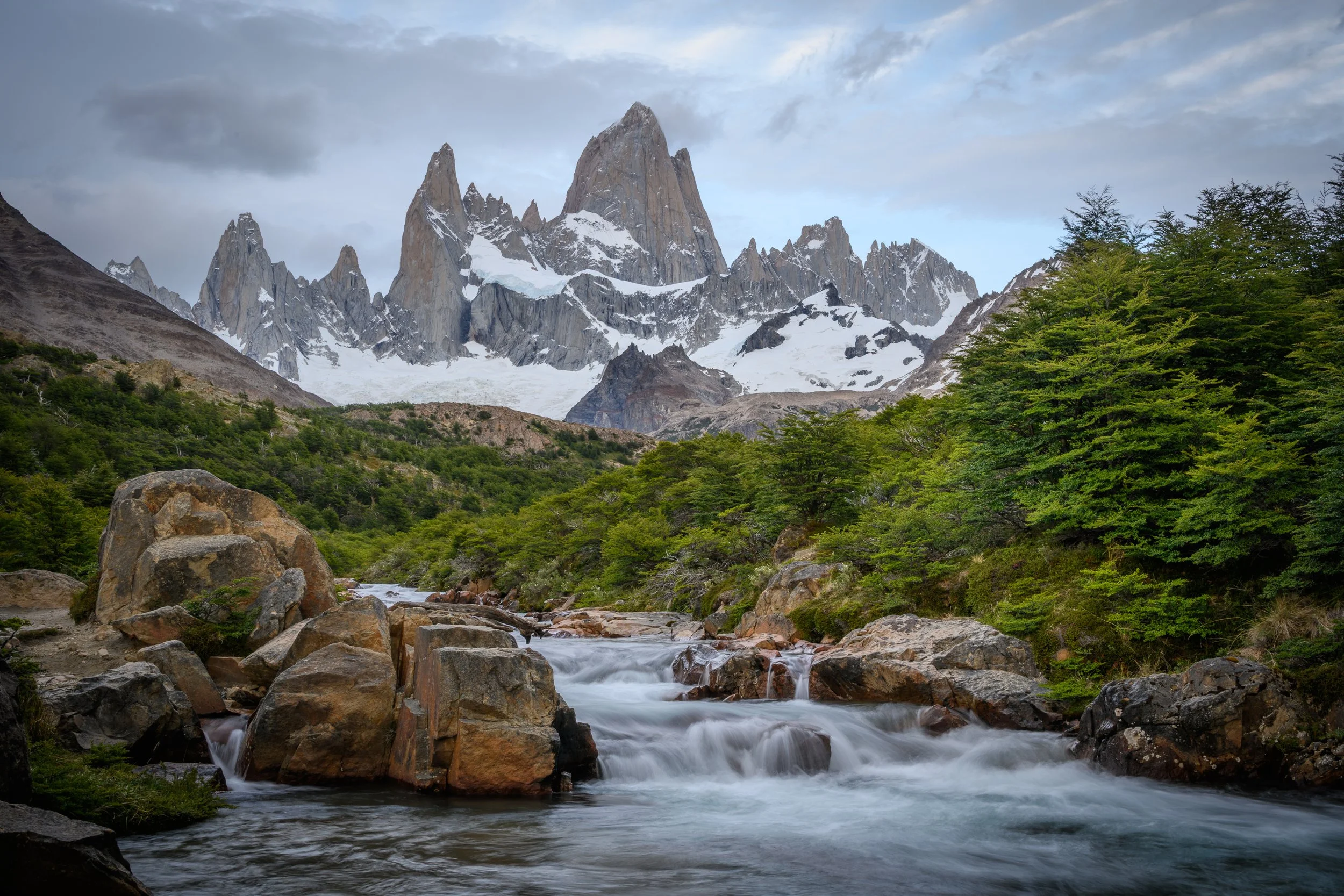
The mighty Fitzroy range and the Rio (river) Fitzroy.
The weather here is famously dreadful, and there are many stories of climbers making the El Chaltén pilgrimage with a view to climbing on its mountains, only to be shut down by relentless storms for weeks on end. The story is similar for the Torres del Paine park too, but we were very fortunate throughout our Patagonian adventure.
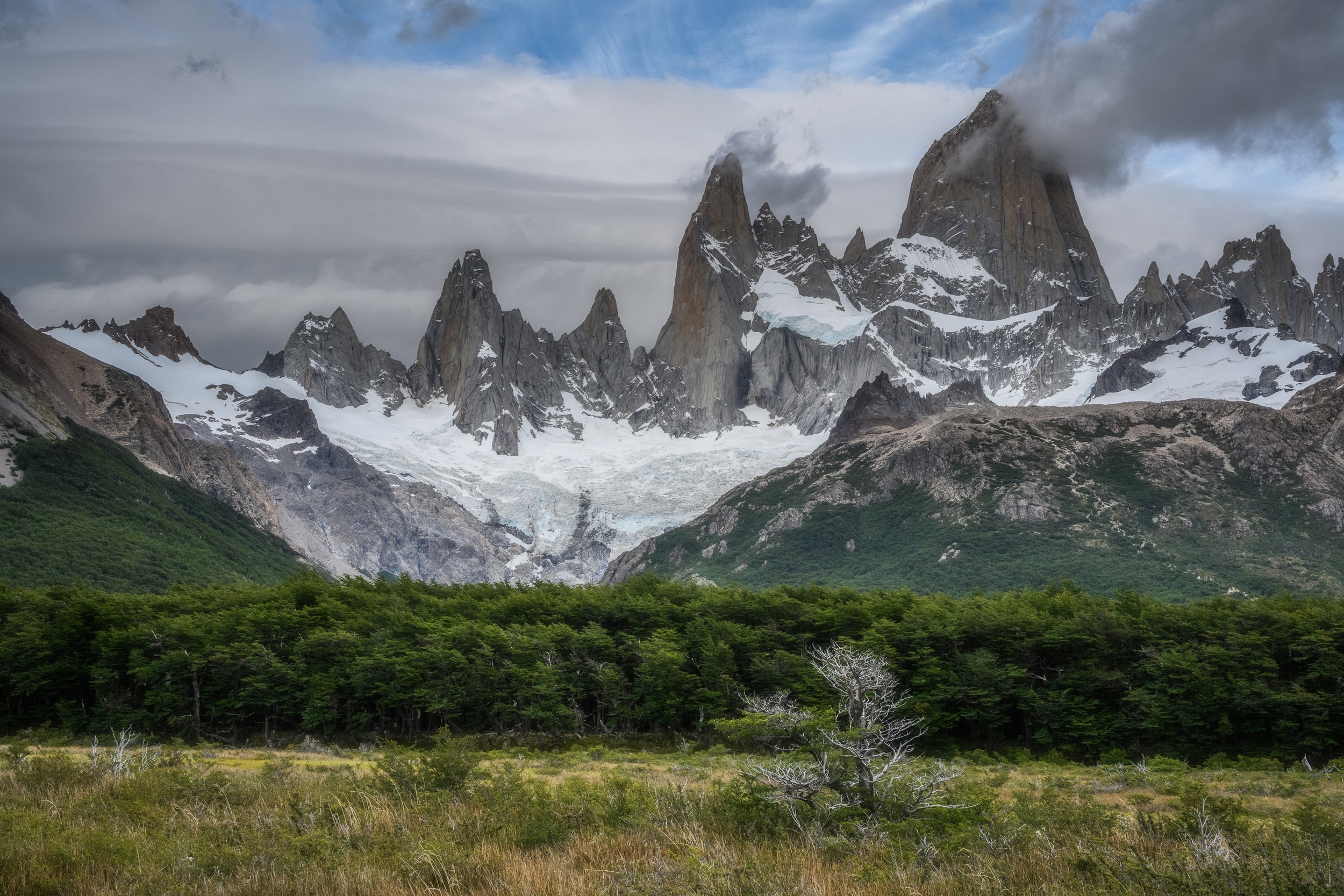
Another view of ‘those’ peaks. They are astonishingly addictive. The eye is constantly drawn to them and it’s almost impossible NOT to take pictures.
In the 4 weeks we spent in Patagonia, I think we put waterproofs on twice, and even then this was only for a relatively short part of the day. We were, however, a little unfortunate on our main visit to Cerro Torre. The cloud hung low over this slender finger of rock, and despite waiting for a while, it never fully lifted. Despite this, the landscape is still, undeniably, spectacular.
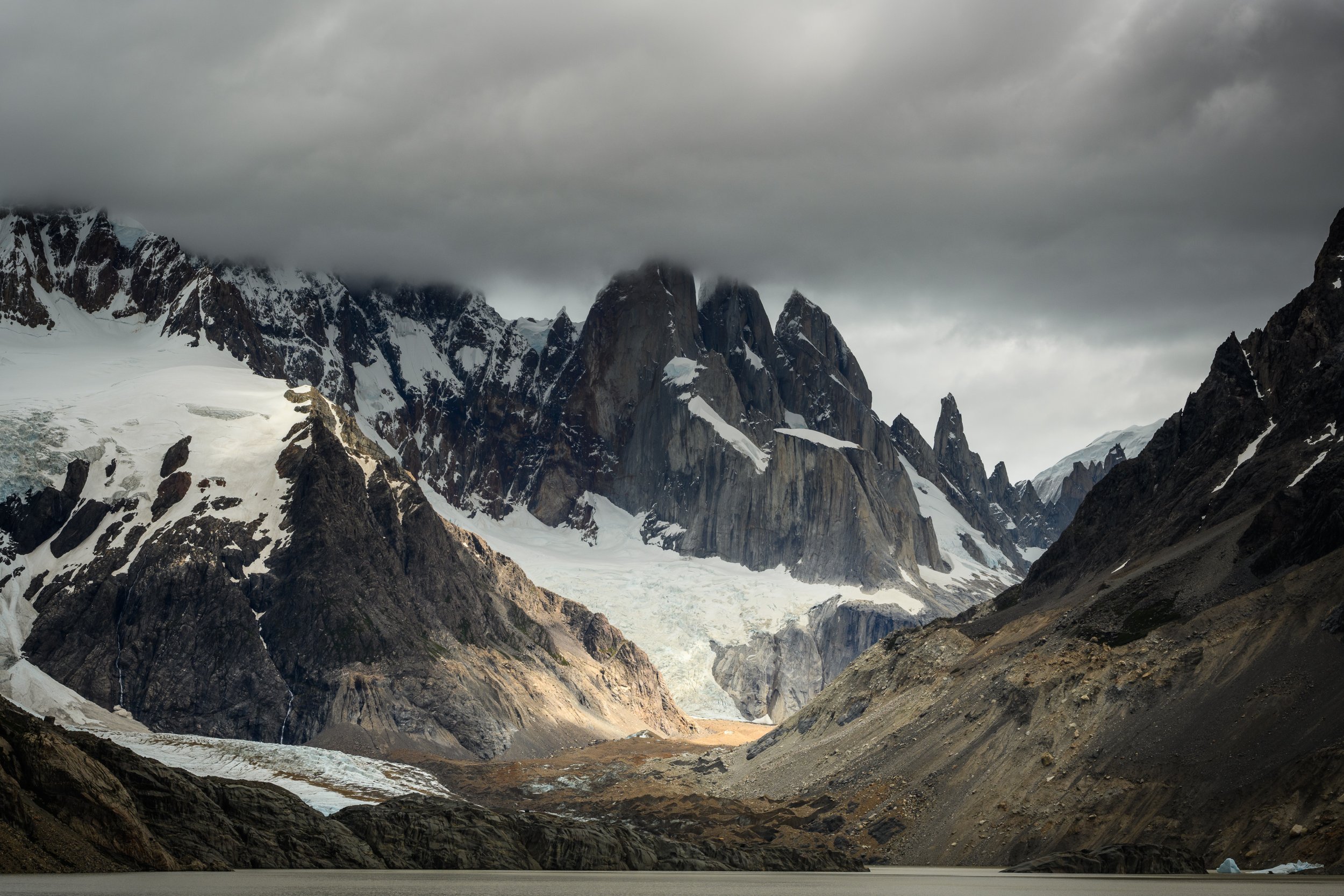
Glaciers, snow and so much rock, but sadly the upper ramparts of Cerro Torre remained in the cloud.
As well as the mountains, once again the landscape here is rich with interest and fascination – lakes, rivers, glaciers and forest, and some amazing skies.
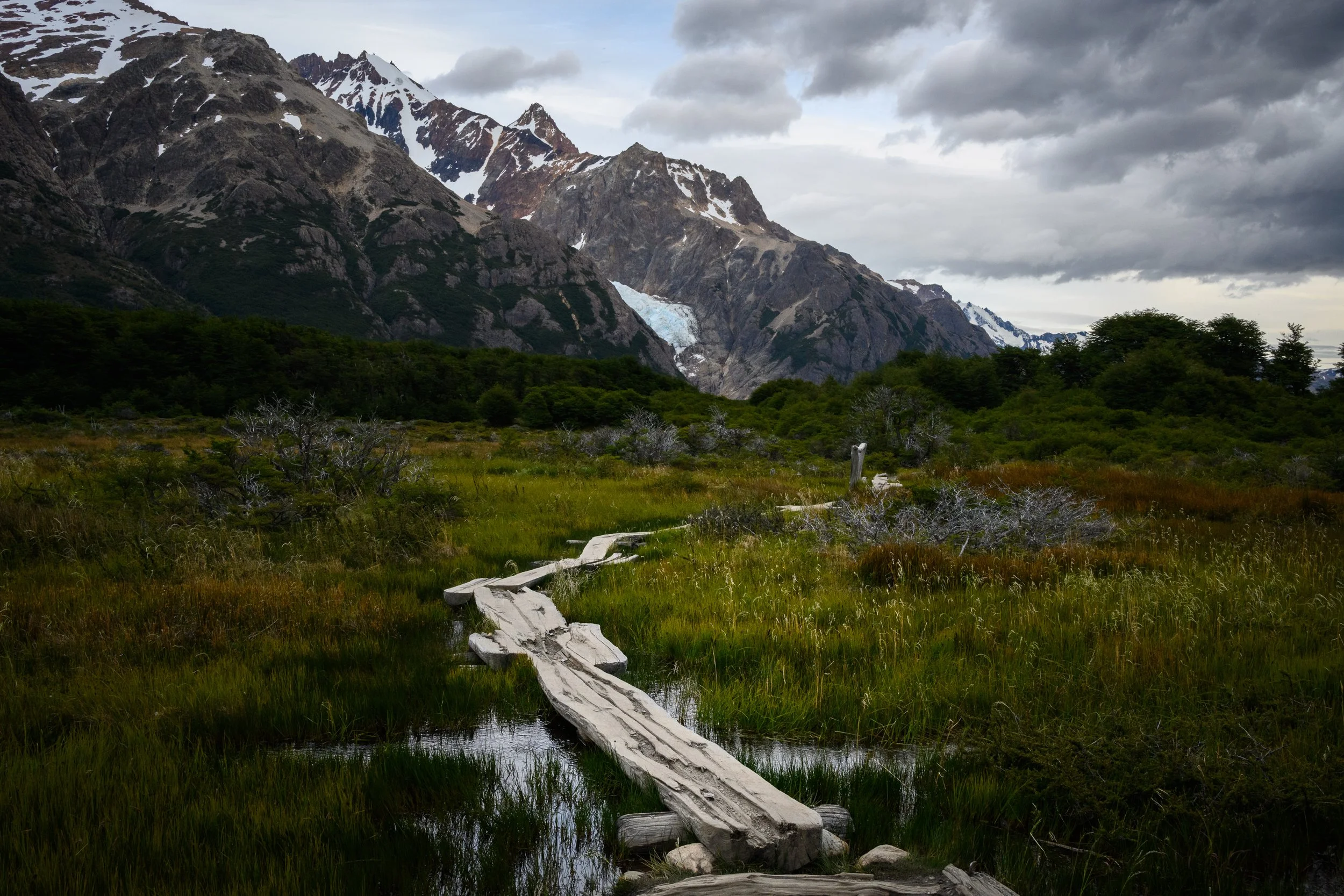
Pathways through the rich wetlands and forests that lie in some of the valleys.
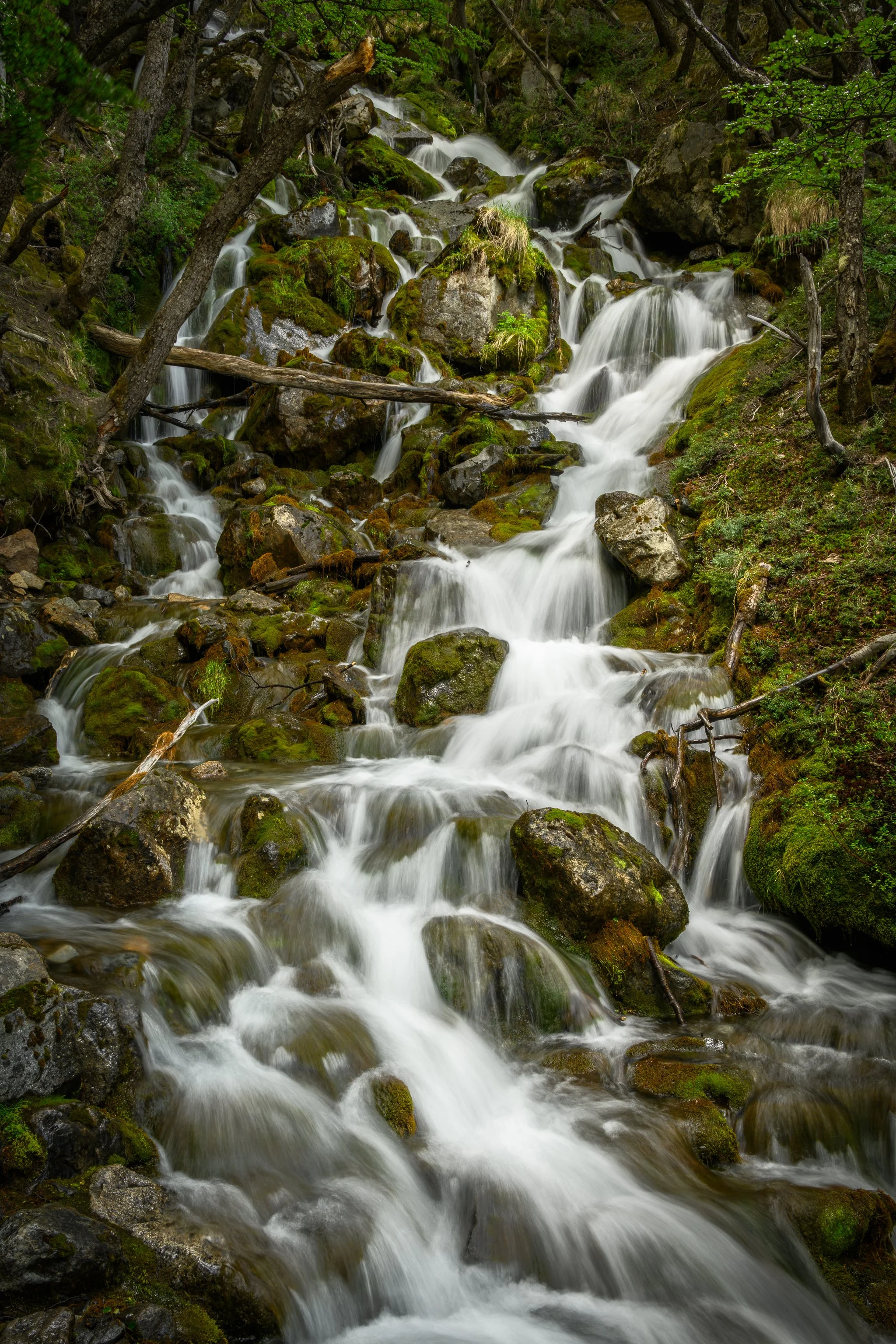
We stumbled across these rapids close to the path leading to Cerro Torre.
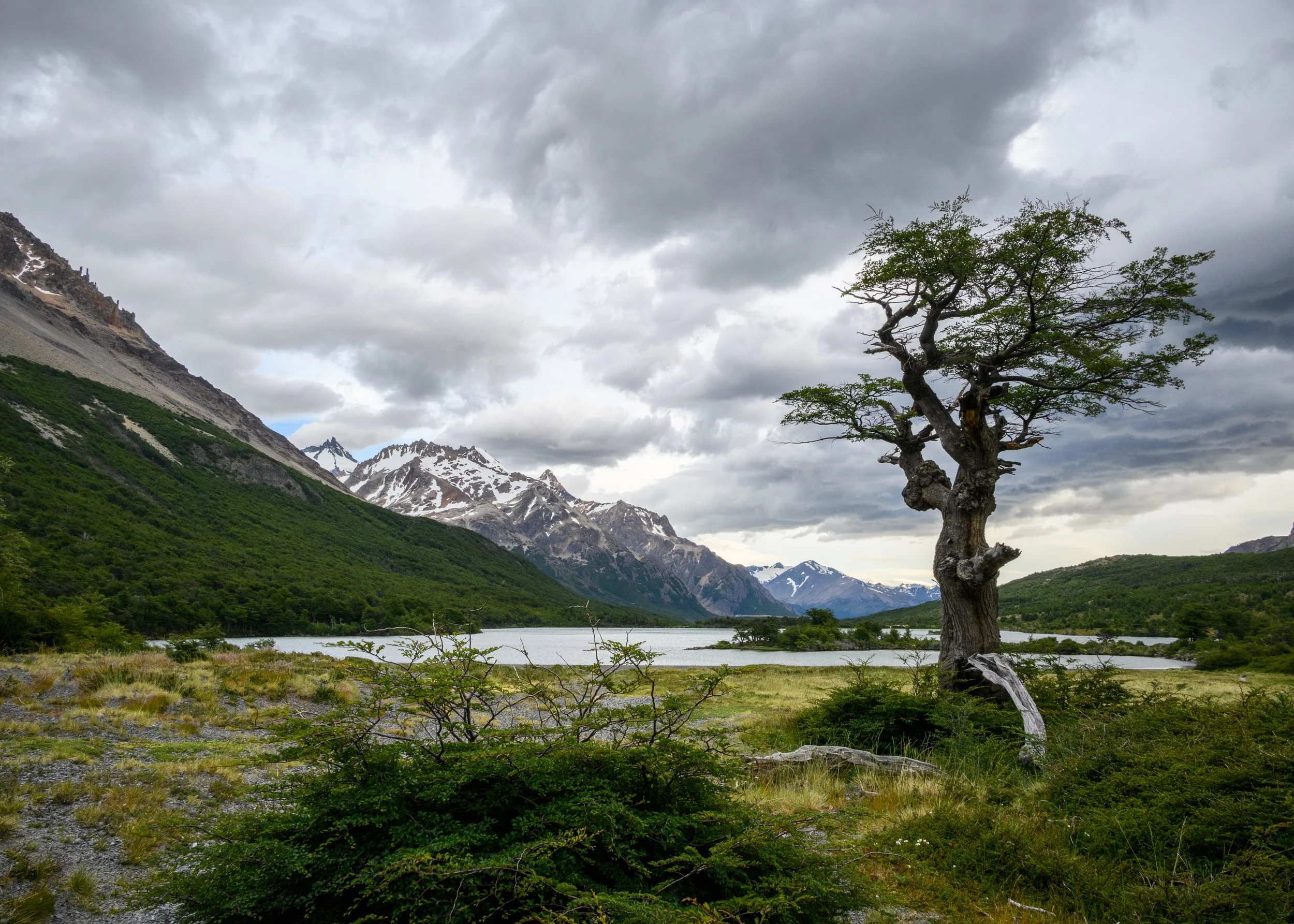
The trees have to be pretty hardy to survive here.
Bariloche San Carlos and Frey
Our final destination - Briloche - was a fairly big town, mainly famous for its Swiss chalets and chocolate. There is so much chocolate here! Our main purpose and reason for visiting this place was in order to head out to a place called Frey. Frey is descried as ‘an immense climbing wonderland’ and is located in Nahuel Huapi National Park, an hour or so bus-ride out of Frey (plus a very steep uphill 10km walk).
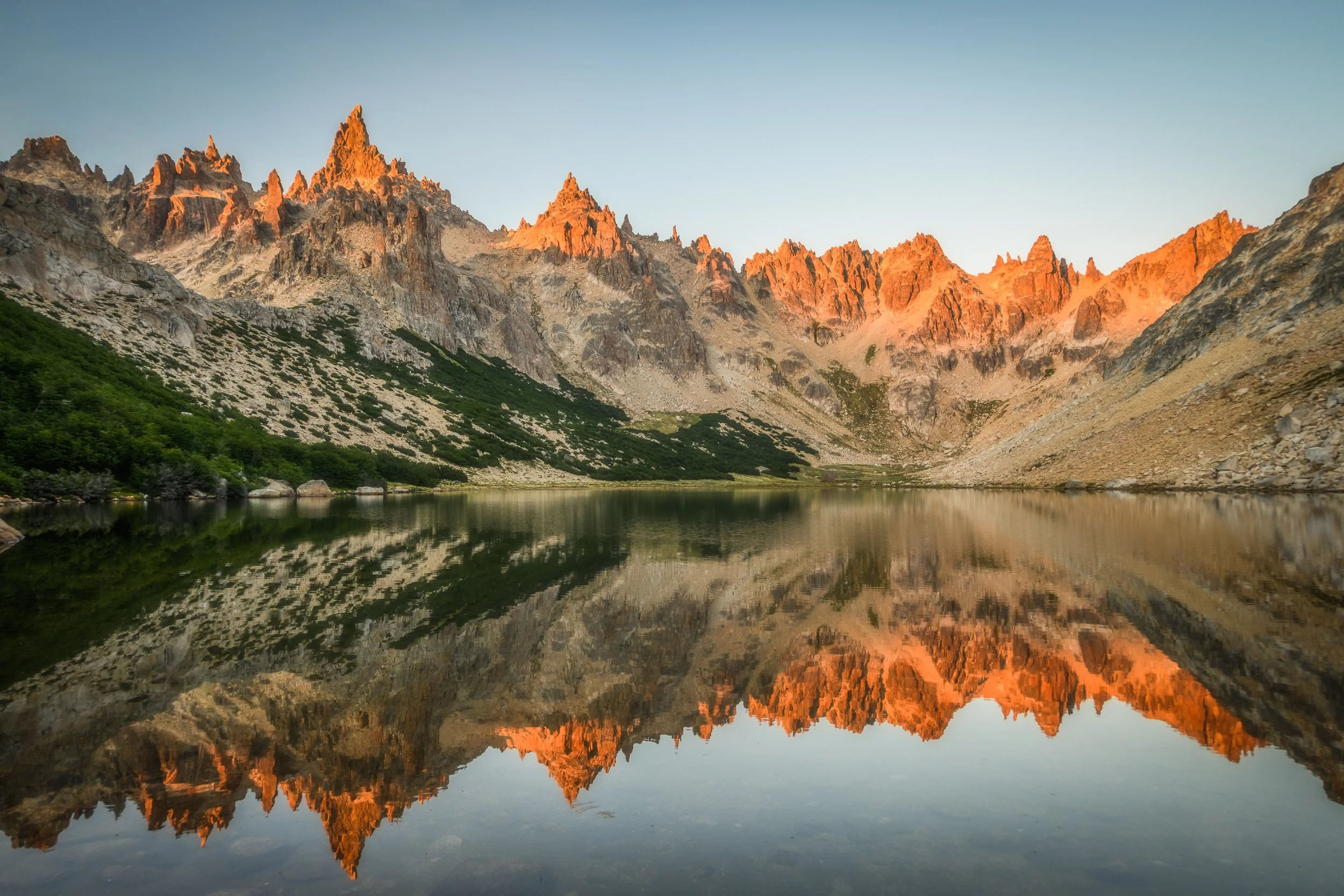
Frey - A mad landscape of stunning granite spires. An adventurous climbing paradise.
Frey is a spectacular mountain cirque, home to a small and basic mountain hut and a lake, and ringed by granite spires all around. Our objective here was rock climbing, and so photography very much took the back foot. However, my little Z30 really came up trumps here, and enabled me to take a few images. Given this venue’s relative remoteness, the skies were immense, made even more so by the again, great weather.
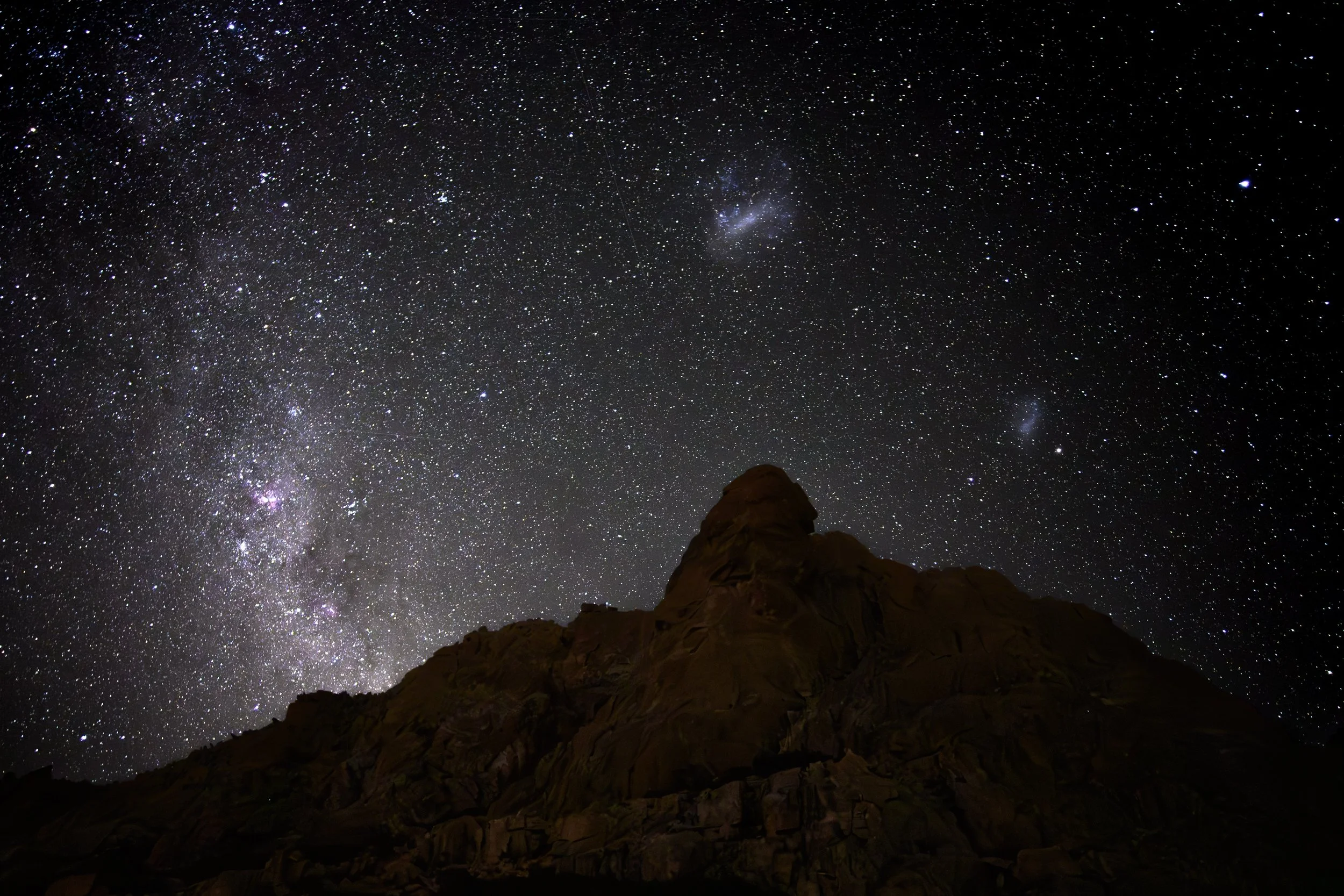
The skies above Frey were spectacularly clear and the stars were immense.
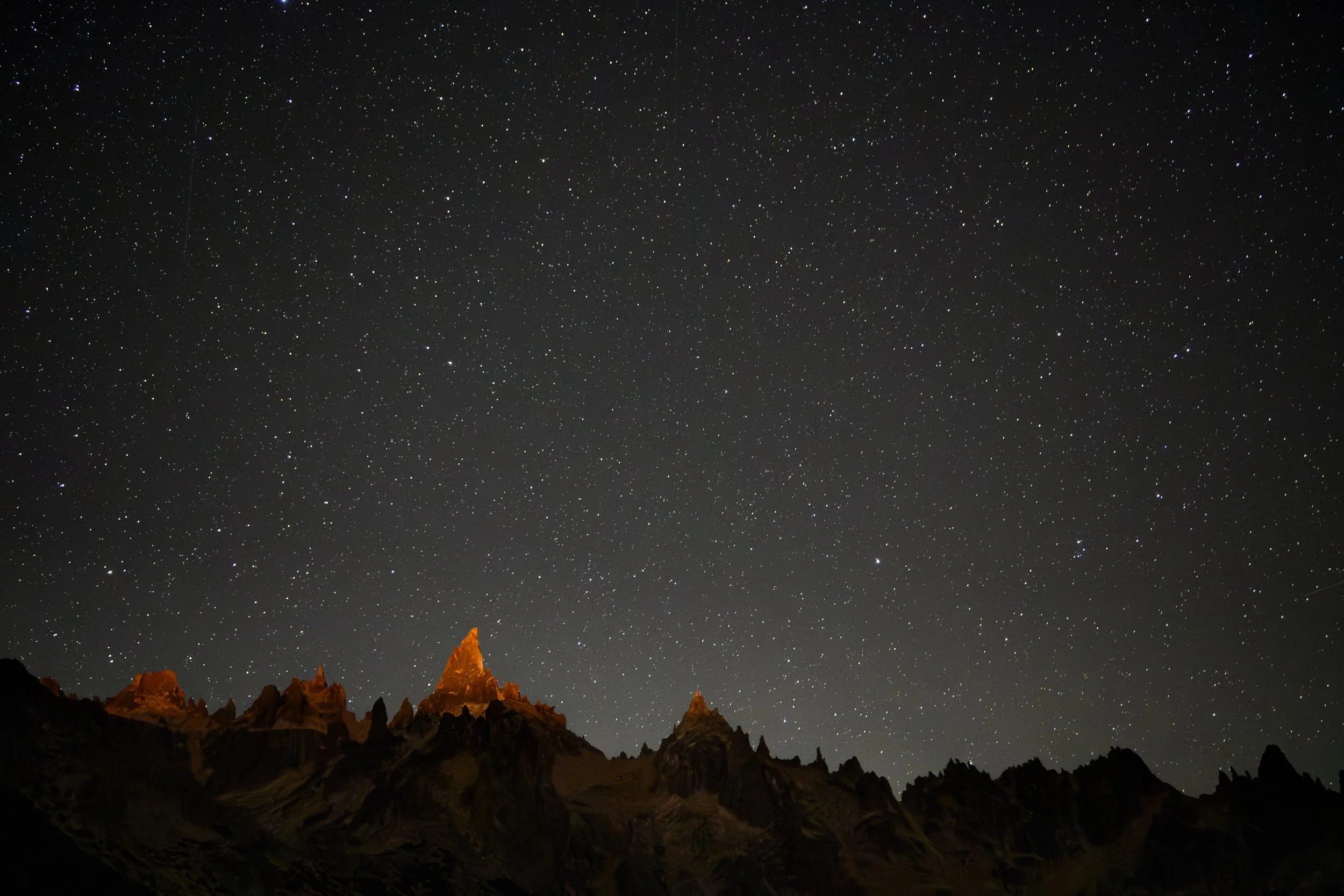
Moon-glow illuminating Torre Principal - the highest of all the towers at Frey.
Patagonia is spectacular. My wife and I had long-dreamed of visiting, and when we first decided to do so, the initial planning was quite overwhelming. It’s a vast place and there is so much to see and do, and of course to photograph. There were many other locations we could have visited, but our focus on three main venues for a good chunk of time each, worked very well for us. We weren’t chasing perfect photographic conditions for much of our trip. There were a couple of morning where photography was the key objective, but for much of the time, my photography was opportunistic. This style of photography has its drawbacks, in that you don’t get to spend lots of time waiting for the right light. However, it also has some real benefits. It means you cover more ground and so get to see much more. You often don’t know what’s around the next corner, and this leads to real excitement and joy when you come upon something spectacular, or the weather comes good for you. I enjoy this style of photography very much, alongside the more patient waiting-game, and pursuing a mixture of the two helps to make photography as exciting a hobby as it has ever been.